LASER Angioplasty in Hyderabad
LASER angioplasty is an advanced interventional procedure that uses high-energy ultraviolet light to ablate — vaporise — plaque and calcified tissue inside a blocked coronary artery. It is a precision tool used in situations where standard balloon angioplasty alone cannot adequately prepare a severely calcified, resistant, or complex artery for stenting. At AIG Hospitals, Gachibowli, Dr. Bhishma Chowdary employs excimer laser coronary angioplasty (ELCA) as part of a comprehensive approach to complex coronary intervention.
At a Glance
| Procedure type | Complex coronary intervention — plaque modification technique |
| Technology | Excimer laser coronary angioplasty (ELCA) — pulsed ultraviolet laser |
| Used for | Calcified lesions, in-stent restenosis, undilatable lesions, CTO crossing, SVG disease |
| Used alongside | Balloon angioplasty and drug-eluting stent placement |
| Duration | 1 to 3 hours (depending on lesion complexity) |
| Anaesthesia | Local anaesthesia + conscious sedation. Awake throughout. |
| Hospital stay | 24 to 48 hours |
| Performed by | Dr. Bhishma Chowdary, DM Cardiology, AIG Hospitals Hyderabad |
| Appointment | +91-9000352998 |
What is LASER angioplasty?
Coronary artery disease progresses over years as cholesterol plaque deposits inside the artery wall. In many patients — particularly older individuals, diabetics, and those with long-standing hypertension — this plaque becomes heavily calcified. Calcium deposits make the artery wall rigid and resistant, like a calcified shell around the blockage. Standard balloon angioplasty pushes plaque sideways against the artery wall, but in heavily calcified arteries, the balloon cannot expand adequately, the stent cannot be properly delivered, and even if placed, the stent may not expand to its full diameter — leading to poor outcomes and high restenosis rates.
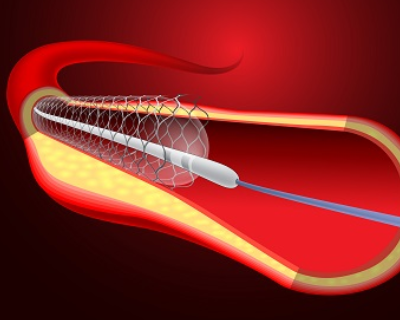
LASER angioplasty addresses this directly. An excimer laser catheter — a fibre-optic catheter tipped with a circular array of laser fibres — is advanced to the blockage site. Pulses of ultraviolet laser energy (308 nanometre wavelength) are delivered in rapid bursts. Each pulse vaporises a tiny layer of plaque and calcium in a photochemical and photomechanical process — breaking molecular bonds rather than burning tissue. This softens, debulks, and modifies the lesion, making the artery wall more compliant and receptive to balloon dilation and stent expansion.