
Cholesterol and Heart Disease — What Your Numbers Actually Mean
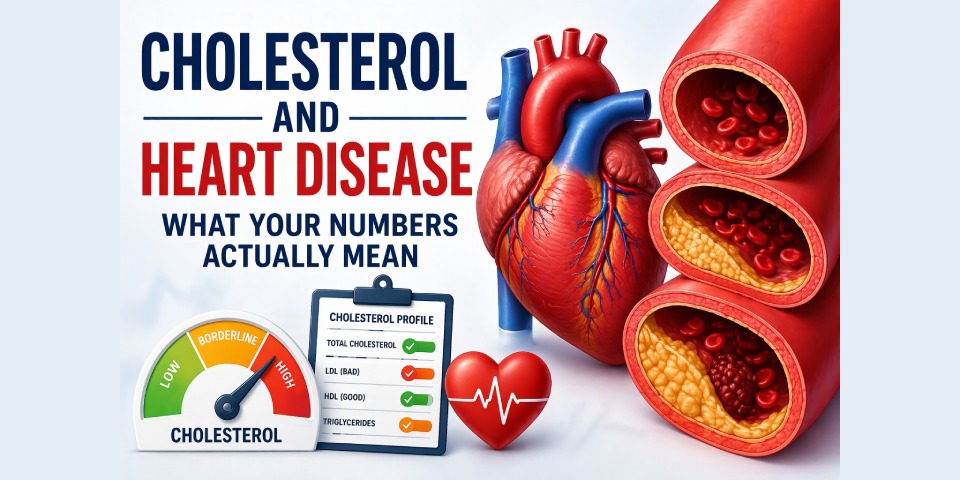
Millions of Indians have their cholesterol checked each year — and most receive a report with numbers they do not fully understand. "Your cholesterol is borderline high" is a phrase that generates anxiety without guidance. This article explains exactly what each number means, what the targets should be, and why standard cholesterol panels miss one of the most important risk factors in South Asians.
Understanding your lipid panel
| Total cholesterol | The sum of all cholesterol fractions. Less informative than the individual components — a normal total cholesterol can hide a dangerous LDL or very low HDL. Use as a screening value only. |
| LDL (Low-Density Lipoprotein) | The primary target for treatment. LDL is the cholesterol deposited in artery walls to form atherosclerotic plaques. Lower is better — always. The target depends on your overall cardiovascular risk category. |
| HDL (High-Density Lipoprotein) | The 'good' cholesterol — carries cholesterol away from arteries back to the liver. HDL above 40 mg/dL in men and above 50 mg/dL in women is desirable. Low HDL is an independent risk factor. |
| Triglycerides | Blood fats reflecting dietary carbohydrate and sugar intake, alcohol, and metabolic health. Should be below 150 mg/dL fasting. Severely elevated triglycerides (above 500) carry a risk of pancreatitis. |
| Non-HDL cholesterol | Total cholesterol minus HDL. Includes all atherogenic (plaque-forming) particles. A better predictor of cardiovascular risk than LDL alone. Target: non-HDL below 85 mg/dL in very high-risk patients. |
What are the right LDL targets?
LDL targets in cardiology are not one-size-fits-all — they depend on your risk category:
| Very high risk (known heart disease, prior heart attack or stent, diabetes with organ damage) | LDL below 55 mg/dL. And a reduction of at least 50% from baseline. This is the 2023 ESC guideline target — much lower than the 'normal range' printed on most lab reports. |
| High risk (diabetes without organ damage, severe hypertension, significant family history) | LDL below 70 mg/dL. |
| Moderate risk (2–3 cardiovascular risk factors, no established disease) | LDL below 100 mg/dL. |
| Low risk (few or no risk factors) | LDL below 116 mg/dL. |
Important
The 'normal range' printed on your cholesterol report (often shown as below 200 mg/dL total cholesterol or below 130 mg/dL LDL) is a population reference range — not a cardiovascular treatment target. If you have had a heart attack or stent, your LDL target is 55 mg/dL — vastly lower than what is shown as 'normal' on most reports. Many patients stop statins because their cholesterol looks 'normal' — when in fact they have not reached their true treatment target.
Lipoprotein(a) — the cholesterol test most doctors do not order
Lipoprotein(a) — written as Lp(a) — is a cholesterol-containing particle in the blood that is genetically determined, almost entirely inherited, and not reduced by standard cholesterol-lowering medications. It is one of the most powerful independent predictors of premature heart attack and stroke — and it is present at elevated levels in approximately 25% of South Asians, compared to 15% globally.
Lp(a) is not included on standard lipid panels. It must be specifically requested. Many patients who have a heart attack in their 30s or 40s with otherwise normal cholesterol levels are found to have markedly elevated Lp(a) — a risk that was present their entire lives but never identified.
- Lp(a) is measured in mg/dL or nmol/L — the unit matters, as conversion factors differ
- An Lp(a) above 50 mg/dL (or above 125 nmol/L) is considered elevated and associated with significantly increased cardiovascular risk
- Statins do not meaningfully lower Lp(a) — and may slightly increase it
- Currently there are no approved medications in India that specifically lower Lp(a), though emerging RNA-based therapies (inclisiran, pelacarsen) are in clinical trials
- Knowing your Lp(a) is elevated is valuable — it informs more aggressive LDL lowering, earlier intervention, and heightened vigilance for symptoms
Dr. Bhishma Chowdary routinely measures Lp(a) in young patients with premature coronary artery disease, patients with a strong family history of early heart attacks, and patients whose LDL is well-controlled on medication but who have continuing plaque progression.