Heart Failure — Symptoms, Causes, and Treatment in Hyderabad
"Heart failure" is one of the most misunderstood terms in medicine. Patients often fear it means their heart has stopped — it has not. Heart failure means the heart muscle has become too weak or too stiff to pump blood as efficiently as the body needs. It is a chronic condition that is manageable with the right treatment, and in many cases the underlying cause is treatable.
What does heart failure feel like?
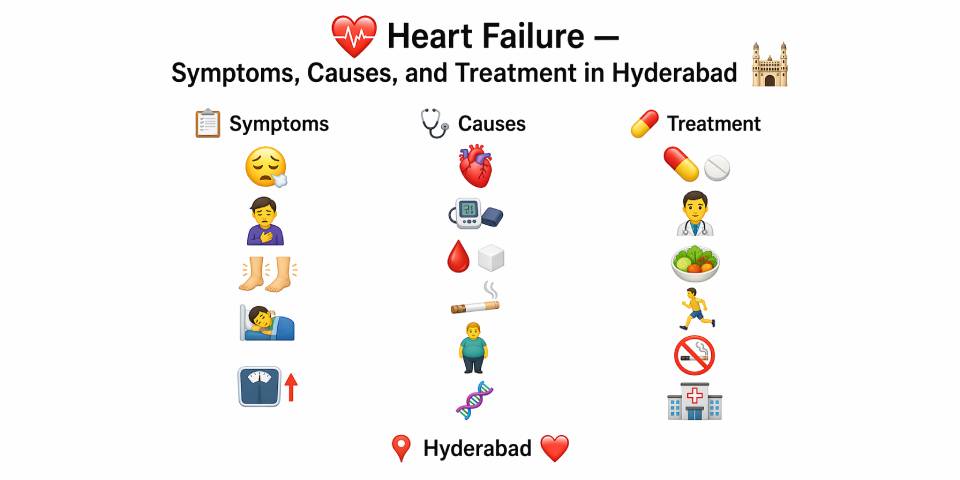
Heart failure produces symptoms from two sources: the heart not pumping enough blood forward (low output) and fluid backing up because the heart cannot clear it (congestion).
| Breathlessness | Initially only on exertion — climbing stairs, walking fast. Progresses to breathlessness at rest and at night (orthopnoea — needing to sleep propped up on multiple pillows to breathe comfortably). |
| Swollen ankles and legs | Fluid retained by the body accumulates in the legs (oedema). Pitting oedema — where a finger pressed into the ankle leaves an indentation — is a classic sign. |
| Fatigue and weakness | Reduced cardiac output means less blood reaching muscles. Even simple activities — showering, cooking — become exhausting. |
| Abdominal bloating | Fluid accumulation in the abdomen (ascites) causes fullness and discomfort. The liver enlarges (hepatomegaly) from venous congestion. |
| Rapid or irregular heartbeat | The failing heart often develops compensatory tachycardia or atrial fibrillation — causing palpitations or an awareness of the heartbeat. |
| Reduced urine output | Kidneys receive less blood and retain fluid, reducing urine production — contributing to the fluid overload cycle. |
Common causes of heart failure in Hyderabad
- Coronary artery disease — prior heart attacks leaving scarred, non-contracting heart muscle (ischaemic cardiomyopathy) — the most common cause
- Hypertension — years of high blood pressure thickening and stiffening the heart muscle (hypertensive heart disease)
- Dilated cardiomyopathy — the heart muscle stretches and weakens without prior heart attack — can be genetic, viral, alcohol-related, or idiopathic
- Valvular heart disease — leaking or narrowed valves (particularly aortic stenosis and mitral regurgitation) overloading the heart
- Atrial fibrillation — an irregular fast heart rhythm that, if uncontrolled for months, progressively weakens the heart muscle (tachycardia-induced cardiomyopathy)
- Uncontrolled diabetes — directly damages the heart muscle (diabetic cardiomyopathy)
- Thyroid disorders — both over- and underactive thyroid can cause or worsen heart failure
HFrEF vs HFpEF — two types of heart failure
Heart failure is classified by whether the pumping function (ejection fraction) is reduced or preserved:
| HFrEF — Heart Failure with reduced EF (EF below 40%) | The heart muscle is weak and contracts poorly. The ventricle is typically dilated (enlarged). This is what most people picture when they think of heart failure. Responds well to several proven drug classes and potentially to CRT devices. |
| HFpEF — Heart Failure with preserved EF (EF above 50%) | The heart contracts normally but is stiff — it cannot relax and fill properly. Common in elderly patients, women, diabetics, and those with hypertension. Symptoms are identical to HFrEF. Treatment is primarily focused on congestion relief and risk factor control. |
Modern treatments for heart failure
Heart failure management has improved dramatically in the last decade. The pillars of treatment for HFrEF (reduced ejection fraction) are:
- GDMT — Guideline-Directed Medical Therapy: four drug classes — ACE inhibitor/ARB/ARNI, beta-blocker, MRA (spironolactone), and SGLT2 inhibitor — have each been shown to reduce mortality and hospitalisation. All four should be used together in eligible patients.
- CRT (Cardiac Resynchronisation Therapy): for patients with bundle branch block and reduced ejection fraction — a special pacemaker that resynchronises the two ventricles and can dramatically improve heart function, sometimes to near-normal levels.
- ICD (Implantable Cardioverter Defibrillator): for patients with EF below 35% who remain at risk of sudden cardiac death despite optimal medical therapy.
- Treating the underlying cause: if heart failure is due to a blocked coronary artery — revascularisation with angioplasty or surgery can restore hibernating heart muscle. If due to aortic stenosis — TAVR or surgical valve replacement can reverse the failure. Identifying and treating the root cause is as important as managing symptoms.
- Diuretics: furosemide and related medications to remove excess fluid — improving breathlessness and oedema. Not disease-modifying but essential for symptom control.
- Heart transplantation and LVAD (Left Ventricular Assist Device): for end-stage heart failure not responding to other treatments — referral to a specialist transplant centre is appropriate.