Why Heart Attacks Are Rising in Young IT Professionals in Hyderabad
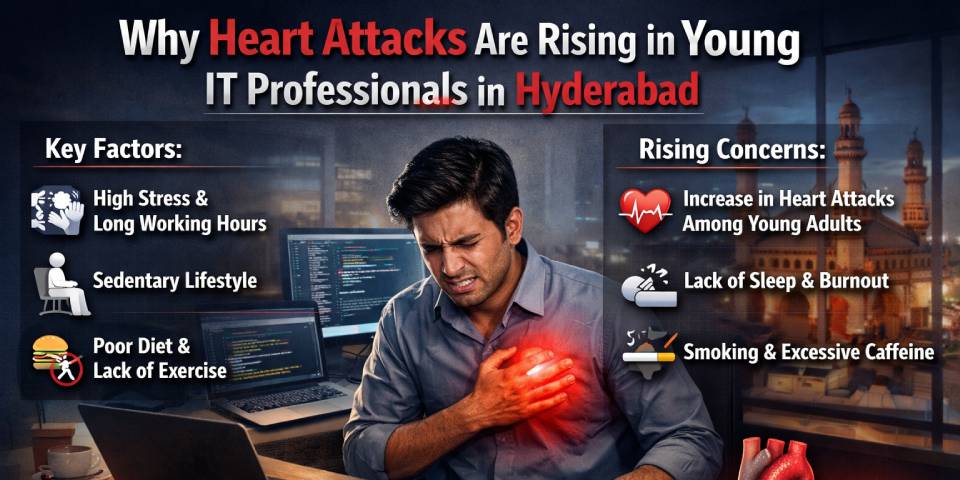
Hyderabad is India's second-largest IT hub. It is also increasingly seeing cardiologists treat heart attacks in patients in their 30s and early 40s — professionals with no prior diagnosis of heart disease, no family history they were aware of, and no reason to suspect they were at risk. The pattern is real, it is well-documented in the cardiology literature, and it is accelerating.
What the data shows
The age at which Indians suffer a first heart attack is 10 to 15 years younger than the Western average. A significant proportion of heart attacks in India now occur in patients under 45. In urban tech-employment centres like Hyderabad, Bengaluru, and Pune, this trend is particularly pronounced. Post-COVID, several studies have documented an additional acceleration in cardiovascular events in younger cohorts.
The specific risk factors converging in Hyderabad's IT workforce
Prolonged sedentary behaviour
Sitting for 8 to 12 hours daily at a desk is an independent cardiovascular risk factor — separate from overall physical activity levels. Even people who exercise regularly but sit for long continuous stretches throughout the workday have elevated cardiovascular risk. Long commute times in Hyderabad's traffic compound this significantly.
Chronic sleep deprivation
Night shift work, irregular hours, and late-night deadlines are endemic in IT. Sleeping fewer than 6 hours per night is associated with a 20% increase in cardiovascular events. Disrupted circadian rhythms affect blood pressure regulation, inflammatory markers, and insulin sensitivity — all direct cardiac risk factors.
Chronic work-related stress
Psychological stress triggers cortisol and adrenaline release, raising blood pressure, promoting inflammation, and — crucially — increasing the tendency for blood clots to form in coronary arteries. Project deadlines, performance reviews, and job insecurity maintain a chronic stress state that is physiologically damaging over years.
Dietary patterns
Long working hours leave little time for home-cooked meals. Hyderabad's food culture — while delicious — is rich in refined carbohydrates, saturated fats, and salt. Canteen food, late-night food delivery, and frequent restaurant meals create a pattern of caloric excess combined with micronutrient depletion. This drives visceral obesity — abdominal fat — which is a stronger cardiac risk factor than peripheral fat.
Genetic predisposition unique to South Asians
South Asians have genetically higher levels of lipoprotein(a) — a cholesterol particle not routinely measured on standard lipid panels that is one of the strongest independent predictors of premature coronary artery disease. Elevated Lp(a) is present in approximately 25% of South Asians, compared to 15% globally. It is not reduced by statins or lifestyle changes — and most people carrying this risk are completely unaware of it.
Undetected diabetes and pre-diabetes
India has a massive burden of undiagnosed type 2 diabetes. Many IT professionals in their 30s have pre-diabetes or early diabetes — detectable only with a fasting glucose or HbA1c test — without any symptoms. Chronically elevated blood sugar silently damages the coronary arteries for years before a first cardiac event.
Warning signs that are often dismissed
Hyderabad's IT professionals are expert at rationalising symptoms that should prompt a doctor visit:
- "Chest tightness when climbing stairs" — dismissed as being unfit
- "Breathlessness in meetings" — attributed to air conditioning or anxiety
- "Jaw ache at the end of a long day" — assumed to be teeth grinding or stress
- "Unusual fatigue after a normal walk" — attributed to poor sleep
Any of these symptoms, particularly in someone with one or more risk factors, deserves a cardiac assessment — not reassurance.